The 15 one-mark questions from the Supplementary 2021 12th Standard Chemistry public exam, in paper order, with the correct option marked and a short explanation.
Q1
The phenomenon observed when a beam of light is passed through a colloidal solution is :
- A. Coagulation
- B. Cataphoresis
- C. Tyndall effectCorrect
- D. Electrophoresis
Explanation. Colloidal particles scatter light, so the path of the beam becomes visible. This scattering is the Tyndall effect.
Q2
The following set of reactions are used in refining Zirconium. This method is called as ______.
\(\mathrm{Zr(impure)} + 2I_2 \xrightarrow{523\,K} ZrI_4\)
\(ZrI_4 \xrightarrow{1800\,K} \mathrm{Zr(pure)} + 2I_2\)
- A. Zone refining
- B. Liquation
- C. Mond's process
- D. Van Arkel processCorrect
Explanation. Impure Zr is converted to volatile \(ZrI_4\), which is then decomposed on a hot filament to give pure Zr. This iodide decomposition method is the Van Arkel process.
Q3
Match the following :
(1) Emulsion (i) Whipped Cream
(2) Gel (ii) Ink
(3) Foam (iii) Cream
(4) Sol (iv) Butter
- A. (1) - (iv), (2) - (iii), (3) - (ii), (4) - (i)
- B. (1) - (iii), (2) - (i), (3) - (ii), (4) - (iv)
- C. (1) - (ii), (2) - (i), (3) - (iv), (4) - (iii)
- D. (1) - (iii), (2) - (iv), (3) - (i), (4) - (ii)Correct
Explanation. Cream is an emulsion (liquid in liquid), butter is a gel (liquid in solid), whipped cream is a foam (gas in liquid) and ink is a sol (solid in liquid).
Q4
The pyrimidine bases present in DNA are :
- A. Cytosine and ThymineCorrect
- B. Cytosine and Adenine
- C. Cytosine and Uracil
- D. Cytosine and Guanine
Explanation. DNA contains the pyrimidines cytosine and thymine; uracil occurs only in RNA, while adenine and guanine are purines. (The paper prints "Thiamine", a misprint for thymine.)
Q5
The pH of an aqueous solution is zero. The solution is :
- A. Neutral
- B. Slightly acidic
- C. Basic
- D. Strongly acidicCorrect
Explanation. pH = 0 means \([H_3O^+] = 10^0 = 1\) M, a very high hydrogen ion concentration, so the solution is strongly acidic.
Q6
On reacting with neutral Ferric Chloride, Phenol gives :
- A. Dark green colour
- B. Red colour
- C. No colouration
- D. Violet colourCorrect
Explanation. Phenol forms a violet coloured iron-phenoxide complex with neutral \(FeCl_3\); this is the test for phenols.
Q7
IUPAC name for the amine \(H_2\ddot{N}-CH_2-(CH_2)_4-CH_2-\ddot{N}H_2\)
- A. Heptane-1, 7-diamine
- B. Hexamethylene diamine
- C. Hexane-1, 6-amine
- D. Hexane-1, 6-diamineCorrect
Explanation. The chain has 1 + 4 + 1 = 6 carbon atoms with \(-NH_2\) groups on C-1 and C-6, so the name is hexane-1,6-diamine. Hexamethylene diamine is only the common name.
Q8
The number of electrons that have a total Charge of 9650 Coulombs is :
- A. \(6.022\times10^{22}\)Correct
- B. \(6.22\times10^{23}\)
- C. \(6.022\times10^{-34}\)
- D. \(6.022\times10^{24}\)
Explanation. 9650 C = 9650/96500 = 0.1 mol of electrons. Number of electrons = \(0.1 \times 6.022\times10^{23} = 6.022\times10^{22}\).
Q9
Which of the following is not \(sp^2\) hybridised ?
- A. Fullerene
- B. Graphite
- C. DiamondCorrect
- D. Graphene
Explanation. In diamond each carbon is bonded tetrahedrally to four other carbons (\(sp^3\)). Fullerene, graphite and graphene contain \(sp^2\) carbons.
Q10
\(CH_3-OH + CO \xrightarrow{Rh/Ir\ complex} ?\)
- A. Poly propylene
- B. Butan-1-al
- C. Acetic acidCorrect
- D. Acetate
Explanation. Carbonylation of methanol with CO over a Rh/Ir complex catalyst (Monsanto process) gives acetic acid. The paper misprints the reactant as \(CH_3-CHO\); the intended reactant is methanol.
Q11
The crystal with a metal deficiency defect is :
- A. ZnO
- B. NaCl
- C. KCl
- D. FeOCorrect
Explanation. In FeO some \(Fe^{2+}\) sites are vacant and the charge is balanced by \(Fe^{3+}\) ions, so the crystal has fewer metal ions (metal deficiency). ZnO shows metal excess.
Q12
In the following reaction,
\(HC\equiv CH \xrightarrow[HgSO_4]{H_2SO_4} X\)
Product 'X' will not give :
- A. Iodoform test
- B. Tollen's test
- C. Fehling solution test
- D. Victor Meyer testCorrect
Explanation. Hydration of acetylene with dil. \(H_2SO_4\)/\(HgSO_4\) gives acetaldehyde (X). Being an aldehyde with a \(CH_3CO-\) group it gives iodoform, Tollen's and Fehling tests; the Victor Meyer test is for alcohols, so X does not give it.
Q13
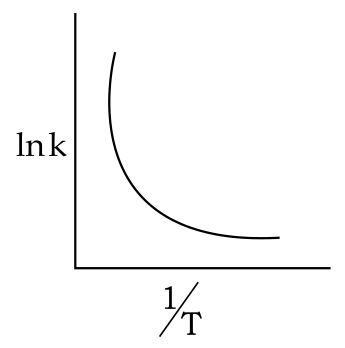
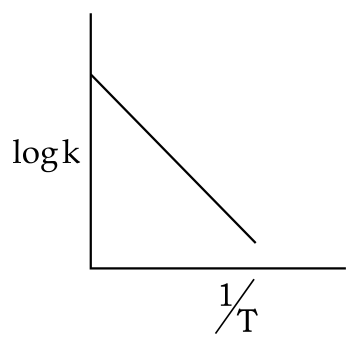
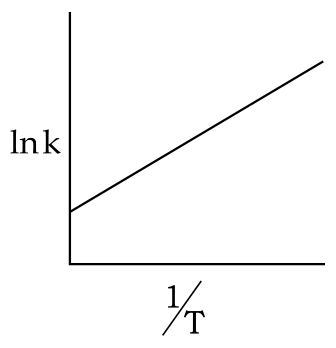
Among the following graphs showing variation of rate constant with temperature (T) for a reaction, the one that exhibits Arrhenius behaviour over the entire temperature range is :
- A. (figure A)
- B. (figure B)Correct
- C. (figure C)
- D. Both (b) and (c)
Explanation. Arrhenius equation: \(\log k = \log A - \frac{E_a}{2.303RT}\), so a plot of log k (or ln k) against 1/T is a straight line with negative slope. Only graph (b) shows this; (a) is a curve and (c) has a positive slope.
Q14
Which one of the following compounds is not formed ?
- A. \(XeF_2\)
- B. \(XeOF_4\)
- C. \(NeF_2\)Correct
- D. \(XeO_3\)
Explanation. Xenon forms fluorides and oxides because its outer electrons are loosely held. Neon is very small with a very high ionisation energy, so \(NeF_2\) is not formed.
Q15
In \(K_4[Fe(CN)_6]\), the co-ordination number of \(Fe^{2+}\) is ______.
- A. 4
- B. 2
- C. 3
- D. 6Correct
Explanation. Six monodentate \(CN^-\) ligands are bonded to the central \(Fe^{2+}\) ion, so its coordination number is 6.