The 15 one-mark questions from the March 2026 12th Standard Zoology public exam, in paper order, with the correct option marked and a short explanation.
Q1
In which type of Parthenogenesis are only males produced?
- A. ArrhenotokyCorrect
- B. Thelytoky
- C. Amphitoky
- D. Both (a) and (c)
Explanation. In arrhenotoky, unfertilised eggs develop only into males (e.g. drones of honey bees). Thelytoky gives only females and amphitoky gives both sexes.
Q2
Statement I: Castration (or) surgical removal of testis is known as Orchidectomy.
Statement II: It leads to difficulty in urination.
- A. Statement I and Statement II are not correct.
- B. Statement I and II are correct.
- C. Statement I is not correct and Statement II is correct.
- D. Statement I is correct and Statement II is not correct.Correct
Explanation. Surgical removal of the testes (castration) is called orchidectomy, so Statement I is correct. Removing the testes affects sperm and testosterone production, not the passage of urine, so Statement II is not correct.
Q3
Select the incorrect action of hormonal contraceptive pills from the following.
- A. Changes in cervical mucus impairing its ability to allow passage and transport of sperms
- B. Inhibition of spermatogenesisCorrect
- C. Alteration in uterine endometrium to make it unsuitable for implantation
- D. Inhibition of ovulation
Explanation. Hormonal pills taken by women inhibit ovulation, change cervical mucus to hinder sperm and make the endometrium unsuitable for implantation. They do not act on spermatogenesis, which occurs in males.
Q4
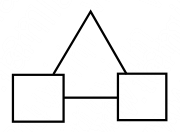
This pedigree symbol represents:
- A. Male
- B. Monozygotic twinsCorrect
- C. Mating
- D. Dizygotic twins
Explanation. Twins are shown by two lines from one point; the horizontal bar joining the two individuals denotes identical (monozygotic) twins. Without the bar the symbol means dizygotic twins.
Q5
Hershey and Chase's experiment with bacteriophage showed that:
- A. DNA contains radioactive sulphur.
- B. Protein gets into the bacterial cells.
- C. Viruses undergo transformation.
- D. DNA is the genetic material.Correct
Explanation. Phages with 32P-labelled DNA passed radioactivity into the bacteria, while 35S-labelled protein coats stayed outside. So DNA, not protein, is the genetic material.
Q6
Find out the wrongly matched pair.
- A. Y-chromosome - 231 genes
- B. Chromosome-1 - 2968 genes
- C. Dystrophin - 2.4 million bases
- D. Human genome - 300 basesCorrect
Explanation. The Human Genome Project found that the Y chromosome has the fewest genes (231), chromosome 1 the most (2968) and dystrophin is the largest gene (2.4 million bases). The human genome has about 3 billion bases, not 300.
Q7
The wings of birds and butterflies is an example of:
- A. Divergent evolution
- B. Adaptive radiation
- C. Variation
- D. Convergent evolutionCorrect
Explanation. Wings of birds and butterflies have different origins and structure but perform the same function (flight). Such analogous organs are an example of convergent evolution.
Q8
Which of the following groups of diseases have been controlled by the use of vaccines and by creating awareness among the people?
- A. Small pox, amoebiasis, diphtheria, tetanus.
- B. Small pox, polio, diphtheria, tetanus.Correct
- C. Small pox, AIDS, diphtheria, tetanus.
- D. Small pox, common cold, diphtheria, tetanus.
Explanation. Small pox, polio, diphtheria and tetanus all have effective vaccines and have been controlled through immunisation and awareness. There are no routine vaccines for amoebiasis, AIDS or common cold.
Q9
Allergy involves:
- A. IgA
- B. IgECorrect
- C. IgM
- D. IgG
Explanation. In allergy, IgE antibodies bind to mast cells and basophils; on re-exposure to the allergen they trigger release of histamine and other mediators.
Q10
The most common substrate used in distilleries for the production of ethanol is ________.
- A. MolassesCorrect
- B. Soya meal
- C. Corn meal
- D. Groundgram
Explanation. Molasses, the by-product of sugarcane factories, is rich in sugars and is the most common substrate fermented by yeast in distilleries to produce ethanol.
Q11
Assertion (A): In nature many organisms produce clones through asexual reproduction.
Reason (R): By this process, genetically identical individuals are produced.
- A. Both Assertion and Reason are false.
- B. Assertion is true, but Reason is false.
- C. Both Assertion and Reason are true but Reason is not the correct explanation of Assertion.
- D. Both Assertion and Reason are true and Reason explains Assertion correctly.Correct
Explanation. Asexual reproduction involves a single parent and no fusion of gametes, so the offspring are genetically identical to the parent, i.e. clones. Hence the Reason correctly explains the Assertion.
Q12
The relationship between sucker fish and shark is ________.
- A. Predation
- B. Competition
- C. Parasitism
- D. CommensalismCorrect
Explanation. The sucker fish (Remora) attaches to the shark and gets transport and food scraps, while the shark is neither benefited nor harmed. This is commensalism.
Q13
The term "Niche" was first used by ________.
- A. John Ray
- B. Charles Darwin
- C. Jordon
- D. Charles EltonCorrect
Explanation. According to the textbook, Charles Elton (1927) was the first ecologist to use the term niche to describe the functional role of an organism in its community.
Q14
Which one of the following are at higher risk of extinction due to habitat destruction?
- A. AmphibiansCorrect
- B. Mammals
- C. Echinoderms
- D. Birds
Explanation. Amphibians depend on both water and land, have moist permeable skin and limited dispersal, so habitat loss affects them most; they are the most threatened vertebrate group.
Q15
________ is/are an ideal disinfectant for waste water.
- A. Boiling
- B. U-V Rays
- C. OzonisationCorrect
- D. Chlorination
Explanation. Ozone is a powerful oxidant that kills pathogens, including chlorine-resistant ones, and breaks down to oxygen without leaving harmful residues, so ozonisation is the ideal disinfectant for waste water.