
Electrostatics: One Mark Questions, Book Back Answers and Notes
Electrostatics is about charges at rest and the forces between them. The unit starts with Coulomb's law and the electric field, moves on to potential, potential energy and Gauss's law, and then covers conductors, dielectrics and capacitors. It ends with the Van de Graaff generator, which builds up very high voltages using the action of points.
Study this chapter
Asked in previous board exams
12 questions from this chapter came in 7 past public exams. Open any of them to see the answer and explanation.
-
March 2026
Two identical conducting balls having positive charges \(q_1\) and \(q_2\) are separated by a centre to centre distance r. If they are made to touch each other and then separated to the same distance, the force between them will be :See answer in the solved paper →
-
March 2026
Which of the following statement is/are true for equipotential surface ?See answer in the solved paper →
-
March 2025
An electric dipole is placed at an alignment angle of 30° with an electric field of \(2\times10^5\ NC^{-1}\). It experiences a torque equal to 8 Nm. The charge on the dipole if the dipole length is 1 cm is :See answer in the solved paper →
-
March 2025
A thin conducting spherical shell of radius R has a charge Q which is uniformly distributed on its surface. The correct plot for electrostatic potential due to this spherical shell is :See answer in the solved paper →
-
March 2024
Two identical conducting balls having positive charges \(q_1\) and \(q_2\) are separated by a center to center distance 'r'. If they are made to touch each other and then separated to the same distance, the force between them will be :See answer in the solved paper →
-
March 2024
Three capacitors are connected in triangle as shown in figure. The equivalent capacitance between the points A and C is :See answer in the solved paper →
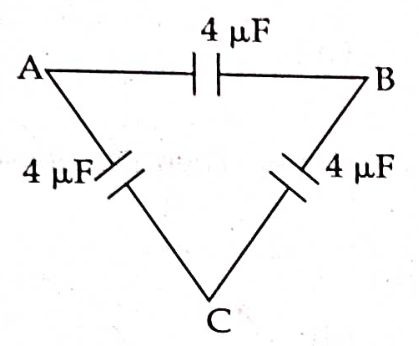
-
March 2023
A parallel plate capacitor stores a charge Q at a voltage V. Suppose the area of the parallel plate capacitor and distance between the plates are each doubled then which is the quantity that will change ?See answer in the solved paper →
-
May 2022
Two metallic spheres of radii 1 cm and 3 cm are given charges of \(-1 \times 10^{-2}\) C and \(5 \times 10^{-2}\) C respectively. If these are connected by a conducting wire, the final charge on the bigger sphere is :See answer in the solved paper →
-
Supplementary 2021
Which charge configuration produces a uniform electric field?See answer in the solved paper →
-
Supplementary 2021
The unit of electric flux is:See answer in the solved paper →
-
March 2020
In the given diagram a point charge +q is placed at the origin O. Work done in taking another point charge −Q from point A to point B is :See answer in the solved paper →
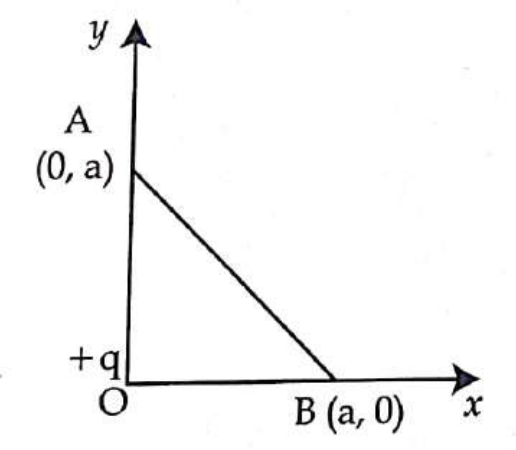
-
March 2020
If voltage applied on a capacitor is increased from V to 2 V, choose the correct conclusion.See answer in the solved paper →
About Electrostatics
Medium ~180 min study
Electrostatics deals with electric charges that are not moving. It is the first unit of Class 12 Physics, and almost everything that follows, from current electricity to electromagnetic waves, uses the ideas you learn here: charge, field, potential and energy.
The unit is built step by step. You start with the force between two point charges, then describe that influence as an electric field \( \vec{E} \) that exists at every point in space. Potential gives a scalar way of describing the same field, which makes many problems much easier. Gauss's law then lets you find the field of a sphere, a long wire or an infinite sheet in a few lines, as long as the charge distribution is symmetric. Finally, capacitors show how charge and energy are stored.
Book back questions from this unit test both ideas and algebra. Expect questions on the field of a dipole, flux through a closed surface, what happens to a capacitor when a dielectric slab is inserted, and series and parallel combinations of capacitors. Keep track of vector directions and units: a missing sign on a charge or a forgotten \( \varepsilon_r \) changes the answer completely.
What you'll learn
- Find the net force on a charge due to several other charges using the superposition principle.
- Derive the electric field and potential due to a point charge and an electric dipole.
- Use Gauss's law to find the field of a charged wire, plane sheet and spherical shell.
- Explain why a dielectric slab increases the capacitance of a parallel plate capacitor.
- Calculate the energy stored in a capacitor and the energy density of its electric field.
- Describe the construction and working of the Van de Graaff generator.
Before you start
- Adding vectors and resolving them into components.
- Newton's laws of motion and the meaning of work done by a force.
- Area vectors, dot products and simple integration.
Topics covered in this chapter
Electrostatics explained
What This Unit Covers
Electric Charge and Coulomb's Law
Charge has two basic properties you must remember: it is quantised (\( q = ne \)) and it is conserved. Coulomb's law gives the force between two stationary point charges. The force is proportional to the product of the charges and inversely proportional to the square of the distance between them. The constant involves \( \varepsilon_0 \), the permittivity of free space. Force is a vector, so when several charges act on one charge, you add the individual forces as vectors. This is the superposition principle.
Electric Field and Potential
The electric field at a point is the force per unit positive charge placed there. Field lines start on positive charges, end on negative charges and never cross. Electric potential at a point is the work done per unit charge in bringing a test charge from infinity to that point. Potential is a scalar, so adding potentials from several charges is simple arithmetic. The same idea gives the potential energy of a system of charges and of a dipole placed in a uniform field.
Gauss's Law
Gauss's law says the total electric flux through any closed surface equals the net charge enclosed divided by \( \varepsilon_0 \). The law is always true, but it helps you find \( \vec{E} \) only when the charge distribution is symmetric. The trick is choosing the right Gaussian surface: a cylinder for an infinitely long charged wire or an infinite plane sheet, and a concentric sphere for a uniformly charged spherical shell.
Conductors and Dielectrics
In a conductor, free electrons move until the electric field inside becomes zero, and any excess charge sits on the outer surface. Because of this, a closed conducting box keeps out external fields. This is electrostatic shielding. In a dielectric there are no free charges. Instead, the molecules get polarised, and the induced charges set up a field that opposes the applied field, so the net field inside the dielectric is reduced.
Capacitors and the Van de Graaff Generator
A capacitor stores charge and energy. For a parallel plate capacitor, capacitance depends on plate area, plate separation and the dielectric between the plates. You need to find the equivalent capacitance of series and parallel combinations and the energy stored, \( U = \frac{1}{2}CV^2 \). The unit ends with the Van de Graaff generator, which uses the action of points and electrostatic induction to build up potentials of several million volts.
Common mistakes to avoid
- Adding electric fields or forces from several charges as plain numbers. They are vectors, so directions must be taken into account.
- Mixing up potential and field. Potential is a scalar and can be zero at a point where the field is not zero, as on the equatorial line of a dipole.
- Using \( \varepsilon_0 \) for a medium. In a medium the permittivity is \( \varepsilon = \varepsilon_r \varepsilon_0 \), so the force becomes smaller by a factor of \( \varepsilon_r \).
- Drawing the dipole moment the wrong way. By convention \( \vec{p} \) points from the negative charge to the positive charge.
- Picking a Gaussian surface that does not match the symmetry, which makes the flux integral hard or gives a wrong answer.
Test yourself on these with the practice test, then check the worked reasoning in the solved MCQs.
Frequently asked questions
What is the difference between electric force and electric field?
Force is the push or pull a charge actually feels. The field is set up in space by the source charge and exists whether or not another charge is placed there. Force on a charge q is simply qE.
Why do electric field lines never cross each other?
At a crossing point the field would have two directions at once. The net field at any point has only one direction, so two field lines cannot intersect.
How does a dielectric increase capacitance?
The dielectric gets polarised and produces a field opposite to the field between the plates. The net field falls, so for the same charge the potential difference is smaller. Since C = Q/V, the capacitance goes up.
What is an equipotential surface?
It is a surface on which every point is at the same potential. No work is done in moving a charge along it, and the electric field is always perpendicular to it.
Is Gauss's law valid for all closed surfaces?
Yes. It holds for any closed surface of any shape. It is only useful for calculating the field when the charge distribution is symmetric enough that E is constant over the chosen surface.
What happens to the energy when two charged capacitors are connected?
Charge flows until both reach a common potential. The total charge stays the same, but the total stored energy after connection is less than before. The difference is lost mainly as heat in the connecting wires, with a little lost as electromagnetic radiation.
Last updated 15 September 2026