
Magnetism and Magnetic Effects of Electric Current: One Mark Questions, Book Back Answers and Notes
This unit starts with bar magnets, magnetic materials and the Earth's magnetic field. It then shows that electric currents produce magnetic fields and uses the Biot-Savart law and Ampere's circuital law to calculate them. The last part covers the force on moving charges and current-carrying conductors, with the cyclotron and the moving coil galvanometer as the main applications.
Study this chapter
Asked in previous board exams
10 questions from this chapter came in 7 past public exams. Open any of them to see the answer and explanation.
-
March 2026
A non conducting charged ring carrying a charge of q, mass m and radius r is rotated about its axis with constant angular speed \(\omega\). The ratio of its magnetic moment with angular momentum is :See answer in the solved paper →
-
March 2026
The potential energy of a magnetic dipole whose dipole moment is \(\vec{p}_m=(-0.5\hat{i}+0.4\hat{j})\) \(Am^2\) kept in uniform magnetic field \(\vec{B}=2\hat{j}\) T :See answer in the solved paper →
-
March 2025
If a material having intensity of magnetisation 500 \(Am^{-1}\) is placed in a magnetising field of 1000 \(Am^{-1}\), then the susceptibility of the material is :See answer in the solved paper →
-
March 2024
A bar magnet of length 'ℓ' and magnetic moment '\(P_m\)' is bent in the form of an arc as shown in figure. The new magnetic dipole moment will be :See answer in the solved paper →
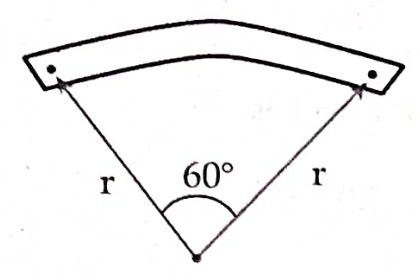
-
March 2023
An example of Diamagnetic material is __________.See answer in the solved paper →
-
May 2022
A wire of length \(l\) carrying a current I along the Y direction is kept in a magnetic field given by \(\vec{B} = \frac{\beta}{\sqrt{3}}(\hat{i} + \hat{j} + \hat{k})\) T. The magnitude of Lorentz force acting on the wire is :See answer in the solved paper →
-
Supplementary 2021
The ratio of magnetic length and geometrical length is:See answer in the solved paper →
-
Supplementary 2021
A particle having mass m and charge q accelerated through a potential difference V. Find the force experienced when it is kept under perpendicular magnetic field \(\vec{B}\).See answer in the solved paper →
-
March 2020
A particle of mass m, carrying charge q is accelerated through a potential of V (Volt). When this accelerated charge comes under the influence of perpendicular magnetic field, the force acting on it is :See answer in the solved paper →
-
March 2020
Magnetic field at any point at a distance R due to a long straight conductor carrying current varies as :See answer in the solved paper →
About Magnetism and Magnetic Effects of Electric Current
Hard ~180 min study
Magnets were known long before electricity was understood, and the magnetic compass was used for navigation for centuries. The big step came when Oersted noticed that a current-carrying wire deflects a compass needle. That observation joined electricity and magnetism, and it is the starting point for electric motors, loudspeakers and the galvanometers in your physics lab.
The unit moves from the familiar to the new. You begin with bar magnets, the magnetic field on the axial and equatorial lines, and the elements of the Earth's magnetic field. Then come the two laws for calculating fields due to currents: the Biot-Savart law for a small current element and Ampere's circuital law for symmetric cases such as a long solenoid or a toroid. After that, you study what a magnetic field does to a moving charge and to a current-carrying wire.
This unit mixes derivations, direction rules and numericals. You need to be confident with the right hand thumb rule, Fleming's left hand rule and the cross product in \( \vec{F} = q(\vec{v} \times \vec{B}) \). These ideas are used again in the next unit on electromagnetic induction and alternating current.
What you'll learn
- Calculate the magnetic field due to a straight conductor, a circular coil and a solenoid.
- Distinguish between diamagnetic, paramagnetic and ferromagnetic materials.
- Use direction rules and the cross product to find the force on a moving charge.
- Explain the construction and working of a cyclotron.
- Derive the expression for the torque on a current loop in a uniform magnetic field.
- Explain how a galvanometer is converted into an ammeter and a voltmeter.
Before you start
- Electric current and potential difference.
- Vector cross product and right hand rules.
- Uniform circular motion and centripetal force.
Topics covered in this chapter
Magnetism and Magnetic Effects of Electric Current explained
What This Unit Covers
Bar Magnets and the Earth's Field
A bar magnet behaves as a magnetic dipole with a north and a south pole. You calculate its magnetic field at a point on the axial line and on the equatorial line, and the torque on it in a uniform field. The Earth also behaves like a huge bar magnet. Its field at a place is described by three elements: magnetic declination, magnetic inclination (dip), and the horizontal component of the Earth's field.
Magnetic Materials
Materials are classified as diamagnetic, paramagnetic or ferromagnetic by how they respond to an external field. The behaviour comes from the magnetic moments of atoms, which arise from the orbital motion and spin of electrons. The hysteresis loop of a ferromagnetic material shows retentivity and coercivity. Materials with high retentivity and coercivity, such as steel, suit permanent magnets. Soft iron, with a narrow loop and low hysteresis loss, suits electromagnets and transformer cores.
Magnetic Field Due to Currents
Oersted's experiment showed that current produces a magnetic field. The Biot-Savart law gives the field due to a small current element. It is used to find the field due to a long straight conductor and on the axis of a circular coil. Ampere's circuital law states that the line integral of \( \vec{B} \) around a closed loop equals \( \mu_0 \) times the current enclosed. It gives quick results for a long straight wire, a solenoid and a toroid.
Force on a Moving Charge and the Cyclotron
A charge moving in a magnetic field feels a force perpendicular to both its velocity and the field. If electric and magnetic fields are both present, the total force is the Lorentz force. In a uniform magnetic field, a charge moving perpendicular to the field goes round in a circle, and one moving at an angle follows a helix. The cyclotron uses this: a magnetic field keeps ions in a circular path while an alternating electric field across the gap between the dees speeds them up every half turn.
Force on Conductors and Torque on a Loop
A current-carrying conductor in a magnetic field experiences a force, and Fleming's left hand rule gives its direction. Two parallel wires carrying currents in the same direction attract, and in opposite directions they repel. The textbook uses this force to define one ampere. A current loop in a uniform field experiences a torque, which is the working principle of the moving coil galvanometer. A galvanometer can be converted into an ammeter with a low resistance shunt in parallel, or into a voltmeter with a high resistance in series.
Common mistakes to avoid
- Taking the magnetic force to be along the magnetic field. The force on a moving charge is perpendicular to both \( \vec{v} \) and \( \vec{B} \).
- Mixing up the rules. The right hand thumb rule gives the direction of the field around a current; Fleming's left hand rule gives the direction of force on a conductor.
- Forgetting that the magnetic force is zero when a charge moves parallel or antiparallel to the field.
- Treating a magnetic pole like an electric charge that can exist alone. Magnetic poles always occur in pairs; no isolated monopole has been found.
Test yourself on these with the practice test, then check the worked reasoning in the solved MCQs.
Frequently asked questions
What is the difference between geographic and magnetic poles?
Geographic poles are where the Earth's axis of rotation meets the surface. Magnetic poles are where the Earth's magnetic field is vertical. They are not at the same place. The angle between the geographic meridian and the magnetic meridian at a place is the magnetic declination, and it varies from place to place.
Why does a magnetic field do no work on a moving charge?
The magnetic force is always perpendicular to the velocity. Work is the dot product of force and displacement, and with a 90 degree angle between them, the work is zero. So the magnetic force can change the direction of motion but not the speed or kinetic energy.
How do we find the direction of the magnetic field around a straight wire?
Use the right hand thumb rule. Hold the wire in your right hand with the thumb pointing along the conventional current. Your curled fingers show the direction of the field lines, which are concentric circles around the wire.
Why is a radial magnetic field used in a moving coil galvanometer?
Concave pole pieces and a soft iron cylinder at the centre make the field radial. The plane of the coil then stays parallel to the field in every position, so the torque for a given current does not change as the coil turns. As a result, the deflection is directly proportional to the current and the scale is uniform.
Can a stationary charge feel a magnetic force?
No. The magnetic force is \( q(\vec{v} \times \vec{B}) \). If the velocity is zero, the force is zero. A magnetic field acts only on charges that are moving.
What happens to a charge moving parallel to a magnetic field?
The angle between velocity and field is 0 or 180 degrees, so \( \sin\theta = 0 \) and the magnetic force is zero. The charge keeps moving in a straight line with the same speed.
Last updated 15 September 2026