The 15 one-mark questions from the March 2025 12th Standard Physics public exam, in paper order, with the correct option marked and a short explanation.
Q1
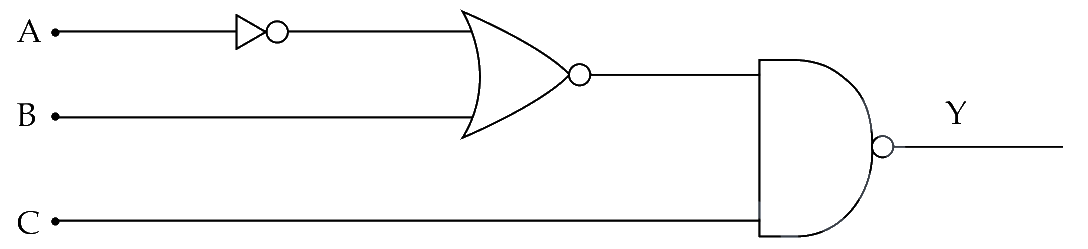
In the combination of the following gates, write the Boolean equation for output Y in terms of input A, B, C.
- A. \(\overline{A}\,B\,\overline{C}\)
- B. \(A\,\overline{B}\,C\)
- C. \(\overline{A}+\overline{B}+\overline{C}\)
- D. \(\overline{A}+B+\overline{C}\)Correct
Explanation. NOR output \(=\overline{\overline{A}+B}=A\overline{B}\). NAND output \(Y=\overline{A\overline{B}\,C}=\overline{A}+B+\overline{C}\).
Q2
If a material having intensity of magnetisation 500 \(Am^{-1}\) is placed in a magnetising field of 1000 \(Am^{-1}\), then the susceptibility of the material is :
- A. 0.2
- B. 0.8
- C. 0.7
- D. 0.5Correct
Explanation. \(\chi_m = M/H = 500/1000 = 0.5\).
Q3
In a transformer, the number of turns in the primary and the secondary are 410 and 1230 respectively. If the current in primary is 6 A, then that in the secondary coil is :
- A. 12 A
- B. 2 ACorrect
- C. 1 A
- D. 18 A
Explanation. \(I_s = I_p\frac{N_p}{N_s} = 6\times\frac{410}{1230} = 2\) A.
Q4
In Joule’s heating law, when R and t are constant, if the H is taken along the y-axis and \(I^2\) along the x-axis, the graph is :
- A. circle
- B. straight lineCorrect
- C. ellipse
- D. parabola
Explanation. \(H = I^2Rt\); with R and t constant, H is directly proportional to \(I^2\), so the H vs \(I^2\) graph is a straight line through the origin.
Q5
The dimension of \(\frac{1}{\mu_0\varepsilon_0}\) is :
- A. \([L^{-1}T]\)
- B. \([LT^{-1}]\)
- C. \([L^{-2}T^{2}]\)
- D. \([L^{2}T^{-2}]\)Correct
Explanation. \(c = \frac{1}{\sqrt{\mu_0\varepsilon_0}}\), so \(\frac{1}{\mu_0\varepsilon_0} = c^2\), whose dimension is \([L^2T^{-2}]\).
Q6
“Ski wax” is an application of nano product in the field of :
- A. SportsCorrect
- B. Medicine
- C. Automotive industry
- D. Textile
Explanation. Nano-based ski wax gives better grip and speed on snow; it is one of the applications of nanotechnology in sports.
Q7
An electric dipole is placed at an alignment angle of 30° with an electric field of \(2\times10^5\ NC^{-1}\). It experiences a torque equal to 8 Nm. The charge on the dipole if the dipole length is 1 cm is :
- A. 5 mC
- B. 4 mC
- C. 7 mC
- D. 8 mCCorrect
Explanation. \(\tau = pE\sin\theta = q(2a)E\sin\theta\), so \(q = \frac{8}{0.01\times2\times10^5\times0.5} = 8\times10^{-3}\) C = 8 mC.
Q8
For light incident from air on a slab of refractive index 2, the maximum possible angle of refraction is :
- A. 60°
- B. 30°Correct
- C. 90°
- D. 45°
Explanation. The angle of refraction is largest for grazing incidence (i = 90°): \(\sin r = \frac{\sin 90^\circ}{2} = \frac{1}{2}\), so r = 30°.
Q9
A radioactive element has \(N_0\) number of nuclei at t = 0. The number of nuclei remaining after half of a half-life (that is, at time \(t = \frac{1}{2}T_{1/2}\)) is :
- A. \(\frac{N_0}{4}\)
- B. \(\frac{N_0}{2}\)
- C. \(\frac{N_0}{8}\)
- D. \(\frac{N_0}{\sqrt{2}}\)Correct
Explanation. \(N = N_0\left(\frac{1}{2}\right)^{t/T_{1/2}} = N_0\left(\frac{1}{2}\right)^{1/2} = \frac{N_0}{\sqrt{2}}\).
Q10
Calculate the distance upto which ray optics is a good approximation for light of wavelength 500 nm falls on an aperture of width 0.5 mm.
- A. 20 cm
- B. 25 m
- C. 25 cmCorrect
- D. 30 cm
Explanation. Fresnel distance (textbook form) \(z = \frac{a^2}{2\lambda} = \frac{(0.5\times10^{-3})^2}{2\times500\times10^{-9}} = 0.25\) m = 25 cm.
Q11
First diffraction minimum due to a single slit of width \(1.0\times10^{-5}\) cm is at 30°. Then wavelength of light used is :
- A. 600 Å
- B. 400 Å
- C. 700 Å
- D. 500 ÅCorrect
Explanation. For the first minimum \(a\sin\theta = \lambda\): \(\lambda = 1.0\times10^{-7}\ m\times0.5 = 5\times10^{-8}\) m = 500 Å.
Q12
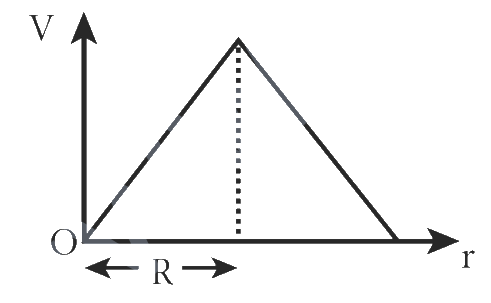
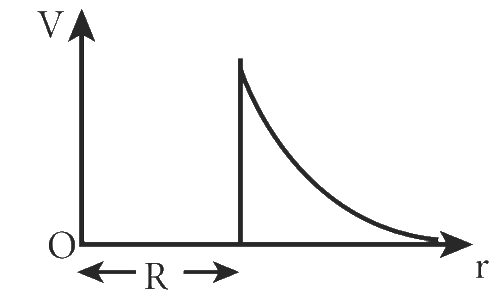
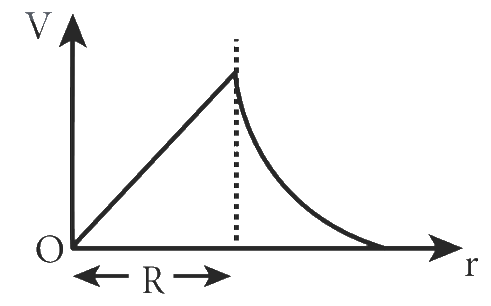
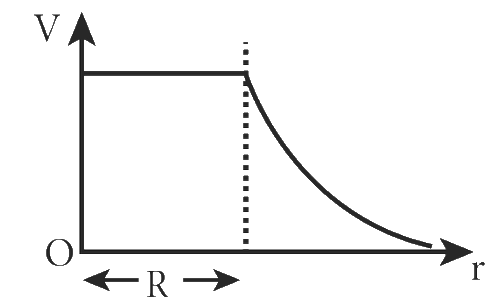
A thin conducting spherical shell of radius R has a charge Q which is uniformly distributed on its surface. The correct plot for electrostatic potential due to this spherical shell is :
- A. (figure A)
- B. (figure B)
- C. (figure C)
- D. (figure D)Correct
Explanation. Inside a charged conducting shell E = 0, so V is constant \(=\frac{Q}{4\pi\varepsilon_0R}\) for r ≤ R; outside, \(V=\frac{Q}{4\pi\varepsilon_0r}\) decreases as 1/r.
Q13
In photoelectric emission, a radiation whose frequency is 4 times threshold frequency of a certain metal is incident on the metal. Then, the maximum possible velocity of the emitted electron will be :
- A. \(2\sqrt{\frac{h\nu_0}{m}}\)
- B. \(\sqrt{\frac{h\nu_0}{m}}\)
- C. \(\sqrt{\frac{h\nu_0}{2m}}\)
- D. \(\sqrt{\frac{6h\nu_0}{m}}\)Correct
Explanation. \(\frac{1}{2}mv^2 = h(4\nu_0) - h\nu_0 = 3h\nu_0\), so \(v = \sqrt{\frac{6h\nu_0}{m}}\).
Q14
To obtain sustained oscillation in an oscillator,
- A. Feedback factor must be unity
- B. Phase shift must be 0 or \(2\pi\)
- C. Feedback should be positive
- D. All the aboveCorrect
Explanation. Barkhausen conditions: loop gain \(|A\beta|\) = 1 and total phase shift 0 or \(2\pi\), which means positive feedback. All the given conditions are needed.
Q15
The transverse nature of light is shown in :
- A. scattering
- B. interference
- C. polarisationCorrect
- D. diffraction
Explanation. Only transverse waves can be polarised; interference and diffraction occur for longitudinal waves too. So polarisation shows that light is transverse.