The 15 one-mark questions from the March 2023 12th Standard Physics public exam, in paper order, with the correct option marked and a short explanation.
Q1
The wavelength \(\lambda_e\) of an electron and \(\lambda_p\) of a photon of same energy E are related by :
- A. \(\lambda_p \propto \frac{1}{\sqrt{\lambda_e}}\)
- B. \(\lambda_p \propto \lambda_e\)
- C. \(\lambda_p \propto \lambda_e^2\)Correct
- D. \(\lambda_p \propto \sqrt{\lambda_e}\)
Explanation. For the photon \(\lambda_p = \frac{hc}{E}\), so \(\lambda_p \propto \frac{1}{E}\). For the electron \(\lambda_e = \frac{h}{\sqrt{2mE}}\), so \(\lambda_e^2 \propto \frac{1}{E}\). Hence \(\lambda_p \propto \lambda_e^2\).
Q2
Two polaroids are kept with their transmission axes inclined at 30°. Unpolarised light of intensity I falls on the first polaroid. Intensity of light emerging from the second polaroid :
- A. \(\frac{1}{8}I\)
- B. \(\frac{1}{4}I\)
- C. \(\frac{3}{8}I\)Correct
- D. \(\frac{3}{4}I\)
Explanation. The first polaroid transmits \(\frac{I}{2}\). By Malus law the second transmits \(\frac{I}{2}\cos^2 30° = \frac{I}{2}\times\frac{3}{4} = \frac{3}{8}I\).
Q3
If the magnitude of the magnetic field is \(3\times10^{-6}\) T, then the magnitude of the electric field for a electromagnetic wave is :
- A. 600 \(Vm^{-1}\)
- B. 100 \(Vm^{-1}\)
- C. 900 \(Vm^{-1}\)Correct
- D. 300 \(Vm^{-1}\)
Explanation. \(E = cB = 3\times10^{8}\times3\times10^{-6} = 900\ Vm^{-1}\).
Q4
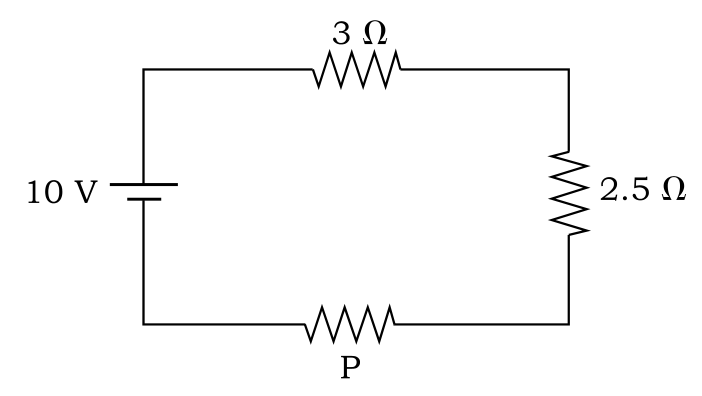
There is a current of 1.0 A in the circuit shown below. What is the resistance of P ?
- A. 3.5 \(\Omega\)
- B. 1.5 \(\Omega\)
- C. 4.5 \(\Omega\)Correct
- D. 2.5 \(\Omega\)
Explanation. Total resistance \(R = \frac{V}{I} = \frac{10}{1.0} = 10\ \Omega\). The resistors are in series, so \(P = 10 - 3 - 2.5 = 4.5\ \Omega\).
Q5
A carbon resistor of \((47\pm4.7)\ k\Omega\) is to be marked with rings of different colours for its identification. The colour code sequence will be :
- A. Violet - Yellow - Orange - Silver
- B. Yellow - Green - Violet - Gold
- C. Green - Orange - Violet - Gold
- D. Yellow - Violet - Orange - SilverCorrect
Explanation. \(47\ k\Omega = 47\times10^{3}\ \Omega\): 4 = Yellow, 7 = Violet, multiplier \(10^3\) = Orange. Tolerance 4.7 is 10% of 47, which is Silver.
Q6
In an hydrogen atom, the electron revolving in the second orbit, has angular momentum :
- A. \(\frac{4h}{\pi}\)
- B. \(h\)
- C. \(\frac{2h}{\pi}\)
- D. \(\frac{h}{\pi}\)Correct
Explanation. By Bohr's quantisation condition \(L = \frac{nh}{2\pi}\). For n = 2, \(L = \frac{2h}{2\pi} = \frac{h}{\pi}\).
Q7
In Young's double-slit experiment, the slit separation is doubled. To maintain the same fringe spacing on the screen, the screen-to-slit distance D must be changed to :
- A. \(\sqrt{2}D\)
- B. \(2D\)Correct
- C. \(\frac{D}{\sqrt{2}}\)
- D. \(\frac{D}{2}\)
Explanation. Fringe width \(\beta = \frac{\lambda D}{d}\). If d becomes 2d, D must become 2D to keep \(\beta\) unchanged.
Q8
A parallel plate capacitor stores a charge Q at a voltage V. Suppose the area of the parallel plate capacitor and distance between the plates are each doubled then which is the quantity that will change ?
- A. Voltage
- B. Capacitance
- C. Energy densityCorrect
- D. Charge
Explanation. \(C = \frac{\varepsilon_0 A}{d}\) is unchanged, so Q and V stay the same. But the field \(E = \frac{V}{d}\) is halved, so energy density \(u = \frac{1}{2}\varepsilon_0 E^2\) becomes one-fourth.
Q9
An electromagnetic wave is propagating in a medium with velocity \(\vec{v} = v\hat{i}\). The instantaneous oscillating electric field of this electromagnetic wave is along +Y axis, then the direction of oscillating magnetic field of the electromagnetic wave will be along :
- A. +Z directionCorrect
- B. −Y direction
- C. −Z direction
- D. −X direction
Explanation. The wave travels along \(\vec{E}\times\vec{B}\). Since \(\hat{j}\times\hat{k} = \hat{i}\), with E along +Y the field B must be along +Z.
Q10
For light incident from air on a slab of refractive index 2, the maximum possible angle of refraction is :
- A. 60°
- B. 30°Correct
- C. 90°
- D. 45°
Explanation. Maximum angle of incidence is 90°. \(\sin r = \frac{\sin 90°}{2} = \frac{1}{2}\), so r = 30°.
Q11
The Zener diode is primarily used as :
- A. Oscillator
- B. Rectifier
- C. Voltage regulatorCorrect
- D. Amplifier
Explanation. In reverse breakdown the voltage across a Zener diode stays nearly constant, so it is mainly used as a voltage regulator.
Q12
The flux linked with a coil at any instant t is given by \(\Phi_B = 15t^2 - 50t + 250\). The induced emf at t = 3 s is :
- A. −40 VCorrect
- B. −190 V
- C. 40 V
- D. −10 V
Explanation. \(\varepsilon = -\frac{d\Phi_B}{dt} = -(30t - 50)\). At t = 3 s, \(\varepsilon = -(90 - 50) = -40\ V\).
Q13
An example of Diamagnetic material is __________.
- A. Nickel
- B. WaterCorrect
- C. Aluminium
- D. Iron
Explanation. Water is diamagnetic. Aluminium is paramagnetic, while nickel and iron are ferromagnetic.
Q14
What is value of Forbidden Energy gap for silicon at room temperature ?
- A. 0.3 eV
- B. 0.7 eV
- C. 0.9 eV
- D. 1.1 eVCorrect
Explanation. The forbidden energy gap of silicon at room temperature is about 1.1 eV (germanium is about 0.7 eV).
Q15
The alloys used for muscle wires in Robots are :
- A. Gold silver alloys
- B. Shape memory alloysCorrect
- C. Two dimensional alloys
- D. Gold copper alloys
Explanation. Muscle wires in robots are made of shape memory alloys (such as Nitinol), which contract when heated and regain their shape.