
Electronics and Communication: One Mark Questions, Book Back Answers and Notes
This unit has two parts. The electronics part covers energy bands, intrinsic and extrinsic semiconductors, the p-n junction diode, rectifiers, the Zener diode, transistors and logic gates. The communication part covers the elements of a communication system, amplitude, frequency and phase modulation, and ground wave, sky wave and space wave propagation.
Study this chapter
Asked in previous board exams
13 questions from this chapter came in 7 past public exams. Open any of them to see the answer and explanation.
-
March 2026
The principle based on which a solar cell operates is :See answer in the solved paper →
-
March 2026
The range of the antenna is 64 km, then its height is (Radius of the earth is 6400 km) :See answer in the solved paper →
-
March 2025
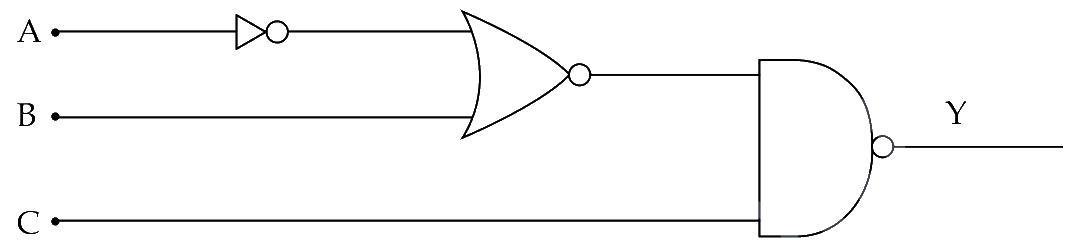
In the combination of the following gates, write the Boolean equation for output Y in terms of input A, B, C.See answer in the solved paper →
-
March 2025
To obtain sustained oscillation in an oscillator,See answer in the solved paper →
-
March 2024
The principle based on which a solar cell operates is :See answer in the solved paper →
-
March 2024
The value of forbidden energy gap for Si at room temperature is :See answer in the solved paper →
-
March 2023
The Zener diode is primarily used as :See answer in the solved paper →
-
March 2023
What is value of Forbidden Energy gap for silicon at room temperature ?See answer in the solved paper →
-
May 2022
The variation of frequency of carrier wave with respect to the instantaneous amplitude of the modulating signal is called :See answer in the solved paper →
-
Supplementary 2021
The Zener diode is primarily used as:See answer in the solved paper →
-
March 2020
The frequency range of 30 MHz to 400 GHz is used for :See answer in the solved paper →
-
March 2020
Type of material which emits white light in LED :See answer in the solved paper →
About Electronics and Communication
Hard ~150 min study
Every mobile phone, computer and television runs on semiconductor devices. Early electronics used vacuum tubes, which were large and wasted a lot of power. Diodes and transistors made from silicon and germanium replaced them because they are small, cheap and efficient. To understand how they work, you need to know how electrons and holes move inside a semiconductor.
The unit builds step by step. Energy bands explain why some solids conduct and others do not. Doping produces n-type and p-type semiconductors, and joining the two gives a p-n junction. The diode leads to rectifiers and voltage regulators, and the transistor leads to amplifiers and switches. Logic gates, the basis of digital circuits, come next.
Short answers and numericals both come from this unit. Be ready to draw diode characteristics, explain rectifiers, relate the current gains α and β, write truth tables and prove De Morgan's theorems. In the communication section, know why modulation is needed and which frequency range suits each mode of propagation.
What you'll learn
- Classify solids as conductors, insulators and semiconductors using energy band diagrams.
- Explain the forward and reverse bias characteristics of a p-n junction diode.
- Explain how half wave and full wave rectifiers convert AC into DC.
- Calculate α and β for a transistor and use the relation between them.
- Write truth tables for basic and universal logic gates and verify De Morgan's theorems.
- Identify the parts of a communication system and explain the need for modulation.
- Distinguish between ground wave, sky wave and space wave propagation.
Before you start
- Atomic structure and the arrangement of electrons in shells.
- Ohm's law and simple DC circuits.
- Properties of electromagnetic waves such as frequency and wavelength.
Topics covered in this chapter
Electronics and Communication explained
Semiconductors, Gates and Signals
Energy Band Theory
In a solid, the energy levels of atoms spread into bands. The valence band and conduction band are separated by a forbidden energy gap. In conductors the bands overlap. In insulators the gap is large, more than about 3 eV. In semiconductors it is small, about 1.1 eV for silicon and 0.7 eV for germanium, so some electrons can cross it at room temperature.
Intrinsic and Extrinsic Semiconductors
A pure semiconductor is intrinsic, with equal numbers of electrons and holes. Adding a small amount of impurity (doping) makes it extrinsic. A pentavalent impurity such as phosphorus gives an n-type semiconductor, where electrons are the majority carriers. A trivalent impurity such as boron gives a p-type semiconductor, where holes are the majority carriers.
P-N Junction
When p-type and n-type regions are joined, electrons and holes diffuse across the junction and recombine. This leaves a depletion region with no free carriers and creates a potential barrier, about 0.7 V for silicon. An external voltage can lower or raise this barrier, which is why the junction conducts easily in one direction only.
Diodes and Their Uses
In forward bias (p-side to the positive terminal) the diode conducts. In reverse bias only a tiny leakage current flows. A half wave rectifier uses one diode to convert AC to pulsating DC, and a full wave rectifier uses two or four diodes to use both halves of the AC cycle. A Zener diode works in reverse breakdown and keeps the voltage across a load nearly constant. The textbook also covers the LED, photodiode and solar cell.
Bipolar Junction Transistor
A transistor has three terminals: emitter, base and collector. A small base current controls a much larger collector current. The current gains are $\alpha = \frac{I_C}{I_E}$ and $\beta = \frac{I_C}{I_B}$, related by $\beta = \frac{\alpha}{1-\alpha}$. For example, if α = 0.98, β = 49. The common emitter configuration is widely used as an amplifier, and a transistor can also act as a switch or an oscillator.
Digital Electronics and Logic Gates
Digital circuits work with two levels, 0 and 1. The basic gates AND, OR and NOT perform logical operations described by Boolean algebra. NAND and NOR are universal gates, since any other gate can be built from either one alone. The EX-OR gate gives output 1 only when its inputs differ. De Morgan's theorems let you convert between AND and OR forms.
Communication Systems
A communication system has a transmitter, a channel and a receiver. The information signal is usually low frequency, so it is placed on a high frequency carrier wave. In amplitude modulation the carrier's amplitude changes with the signal. In frequency modulation its frequency changes, and in phase modulation its phase changes. FM is much less affected by noise than AM, which is why FM radio sounds clearer.
Propagation of Electromagnetic Waves
Ground waves, roughly 2 kHz to 2 MHz, travel along the Earth's surface. Sky waves, roughly 3 MHz to 30 MHz, are bent back to Earth by the ionosphere and can cover very long distances. Space waves, roughly 30 MHz to 400 GHz, travel in straight lines from transmitter to receiver (line of sight) and are used for television, mobile phones and satellite links.
Common mistakes to avoid
- Mixing up forward and reverse bias. Forward bias means the p-side is connected to the positive terminal.
- Mixing up majority carriers. Pentavalent doping gives n-type with electron majority carriers; trivalent doping gives p-type with hole majority carriers.
- Simplifying Boolean expressions carelessly. Check the final expression against a truth table.
- Forgetting phase reversal. In a common emitter amplifier the output is 180° out of phase with the input.
- Mixing up frequency ranges. Sky waves work for about 3 to 30 MHz; above 30 MHz waves pass through the ionosphere and need space wave (line of sight) links.
Test yourself on these with the practice test, then check the worked reasoning in the solved MCQs.
Frequently asked questions
What is the difference between intrinsic and extrinsic semiconductors?
An intrinsic semiconductor is pure silicon or germanium, with equal numbers of electrons and holes, and its conductivity is low at room temperature. An extrinsic semiconductor is doped with a small amount of impurity, which greatly increases the number of electrons (n-type) or holes (p-type) and so increases conductivity.
How does a Zener diode work as a voltage regulator?
The Zener diode is connected in reverse bias, in parallel with the load, with a resistor in series with the supply. Once it reaches breakdown, the voltage across it stays nearly constant. If the input voltage rises, the Zener current increases and the extra voltage drops across the series resistor, so the load voltage stays steady.
Why are transistors called active devices?
A transistor can amplify a signal, giving out more power than it receives at the input, with the extra energy taken from a DC supply. Passive components such as resistors, capacitors and inductors cannot amplify.
Why is modulation needed in communication?
Audio signals have low frequencies and long wavelengths. Since antenna length should be comparable to the wavelength, sending them directly would need antennas several kilometres long. Low frequency signals are also radiated weakly, and signals from different stations would mix. Putting the signal on a high frequency carrier solves all three problems.
Why are NAND and NOR gates called universal gates?
Any other gate, including AND, OR and NOT, can be built using only NAND gates or only NOR gates. For example, joining both inputs of a NAND gate gives a NOT gate. This means any digital circuit can be made from one type of gate.
What does the ionosphere do in sky wave propagation?
The ionosphere is a layer of the upper atmosphere containing charged particles. It bends radio waves of about 3 to 30 MHz back towards the Earth. This lets short wave radio signals travel far beyond the horizon without satellites.
Last updated 15 September 2026