The 15 one-mark questions from the March 2020 12th Standard Physics public exam, in paper order, with the correct option marked and a short explanation.
Q1
The frequency range of 30 MHz to 400 GHz is used for :
- A. Satellite communicationCorrect
- B. Ground wave propagation
- C. Space wave propagation
- D. Sky wave propagation
Explanation. Satellite communication uses microwave frequencies from about 30 MHz to 400 GHz, which pass through the ionosphere. (Space waves also use frequencies above 30 MHz, but the range quoted in the textbook is for satellite communication.)
Q2
In an oscillating LC circuit, the maximum charge on the capacitor is Q. The charge on the capacitor when the energy is stored equally between the electric and magnetic field is :
- A. Q
- B. \(\frac{Q}{2}\)
- C. \(\frac{Q}{\sqrt{3}}\)
- D. \(\frac{Q}{\sqrt{2}}\)Correct
Explanation. Total energy is \(\frac{Q^2}{2C}\). When half is in the electric field, \(\frac{q^2}{2C}=\frac{1}{2}\cdot\frac{Q^2}{2C}\), so \(q=\frac{Q}{\sqrt{2}}\).
Q3
Type of material which emits white light in LED :
- A. GaInNCorrect
- B. SiC
- C. AlGaP
- D. GaAsP
Explanation. Gallium indium nitride (GaInN) is the LED material listed for white light; SiC gives blue, AlGaP green and GaAsP red/yellow light.
Q4
A particle of mass m, carrying charge q is accelerated through a potential of V (Volt). When this accelerated charge comes under the influence of perpendicular magnetic field, the force acting on it is :
- A. \(\sqrt{\frac{2q^3BV}{m^3}}\)
- B. \(\sqrt{\frac{2q^3BV}{m}}\)
- C. \(\sqrt{\frac{q^3B^2V}{2m}}\)
- D. \(\sqrt{\frac{2q^3B^2V}{m}}\)Correct
Explanation. \(qV=\frac{1}{2}mv^2\) gives \(v=\sqrt{\frac{2qV}{m}}\). Then \(F=qvB=qB\sqrt{\frac{2qV}{m}}=\sqrt{\frac{2q^3B^2V}{m}}\).
Q5
Charging current for a capacitor is 0.2 A, find the displacement current.
- A. zero
- B. 0.2 ACorrect
- C. 0.4 A
- D. 0.1 A
Explanation. Between the capacitor plates the displacement current equals the conduction (charging) current, so it is 0.2 A.
Q6
In Bohr Atom Model when the principal quantum number (n) increases the velocity of electron :
- A. increases and then decreases
- B. increases
- C. decreasesCorrect
- D. remains constant
Explanation. In Bohr model the orbital speed \(v_n\propto\frac{Z}{n}\), so the speed decreases as n increases.
Q7
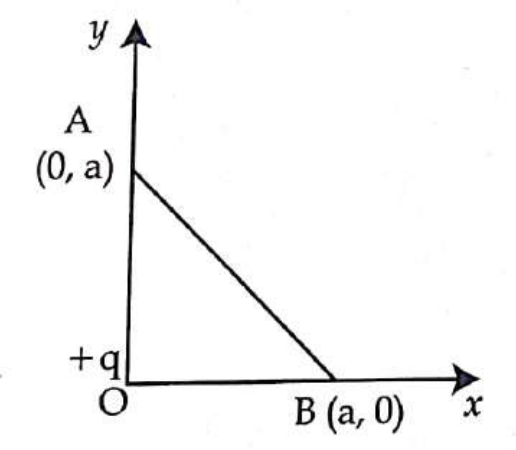
In the given diagram a point charge +q is placed at the origin O. Work done in taking another point charge −Q from point A to point B is :
- A. \(\frac{qQ}{4\pi\epsilon_0 a^2}\left(\frac{a}{\sqrt{2}}\right)\)
- B. ZeroCorrect
- C. \(\left[\frac{-qQ}{4\pi\epsilon_0}\frac{1}{a^2}\right]\sqrt{2}a\)
- D. \(\left[\frac{qQ}{4\pi\epsilon_0}\frac{1}{a^2}\right]\sqrt{2}a\)
Explanation. A and B are both at distance a from +q, so they are at the same potential. Work done = charge × potential difference = 0.
Q8
The nucleus is approximately spherical in shape. Then the surface area of nucleus having mass number A varies as :
- A. \(A^{5/3}\)
- B. \(A^{2/3}\)Correct
- C. \(A^{4/3}\)
- D. \(A^{1/3}\)
Explanation. \(R=R_0A^{1/3}\), so surface area \(4\pi R^2\propto A^{2/3}\).
Q9
Two light waves from slit \(S_1\) and \(S_2\) on reaching points P and Q on a screen in Young's double slit experiment have a path difference zero and \(\frac{\lambda}{4}\) respectively. The ratio of light intensities at P and Q will be :
- A. 4 : 1
- B. 3 : 2
- C. \(\sqrt{2}\) : 1
- D. 2 : 1Correct
Explanation. \(I=4I_0\cos^2(\phi/2)\). At P, \(\phi=0\): \(I_P=4I_0\). At Q, \(\phi=\frac{2\pi}{\lambda}\cdot\frac{\lambda}{4}=\frac{\pi}{2}\): \(I_Q=4I_0\cos^2 45^\circ=2I_0\). Ratio = 2 : 1.
Q10
The radius of curvature of curved surface at a thin planoconvex lens is 10 cm and the refractive index is 1.5. If the plane surface is silvered then the focal length will be :
- A. 20 cm
- B. 5 cm
- C. 10 cmCorrect
- D. 15 cm
Explanation. Lens focal length \(f=\frac{R}{\mu-1}=\frac{10}{0.5}=20\) cm. With the plane face silvered, light passes the lens twice and the plane mirror adds no power, so \(F=\frac{f}{2}=10\) cm.
Q11
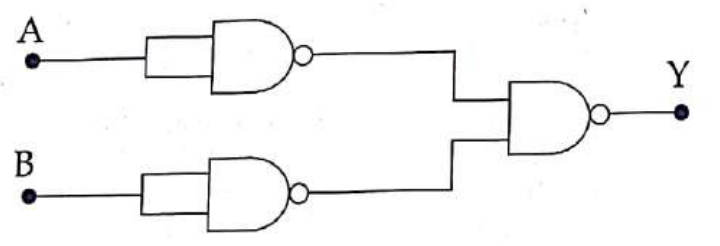
The given electrical network is equivalent to :
- A. NAND gate
- B. OR gateCorrect
- C. NOT gate
- D. Ex-OR gate
Explanation. Each input NAND with shorted inputs acts as NOT, giving \(\bar{A}\) and \(\bar{B}\). The last NAND gives \(Y=\overline{\bar{A}\cdot\bar{B}}=A+B\), which is an OR gate.
Q12
Magnetic field at any point at a distance R due to a long straight conductor carrying current varies as :
- A. \(R^2\)
- B. R
- C. \(\frac{1}{R^2}\)
- D. \(\frac{1}{R}\)Correct
Explanation. \(B=\frac{\mu_0 I}{2\pi R}\), so \(B\propto\frac{1}{R}\).
Q13
If voltage applied on a capacitor is increased from V to 2 V, choose the correct conclusion.
- A. Both Q and C remain the same
- B. Q remains the same, C is doubled
- C. Q is doubled, C is doubled
- D. C remains the same, Q is doubledCorrect
Explanation. Capacitance depends only on the capacitor geometry and dielectric, so C is unchanged; Q = CV, so Q doubles.
Q14
A light of wavelength 500 nm is incident on a sensitive plate of photoelectric work function 1.235 eV. The kinetic energy of the photo electrons emitted is : (Take \(h=6.6\times10^{-34}\) Js)
- A. 1.16 eV
- B. 0.58 eV
- C. 2.48 eV
- D. 1.24 eVCorrect
Explanation. \(E=\frac{hc}{\lambda}=\frac{6.6\times10^{-34}\times3\times10^8}{500\times10^{-9}}=3.96\times10^{-19}\) J \(\approx2.475\) eV. KE = 2.475 − 1.235 = 1.24 eV.
Q15
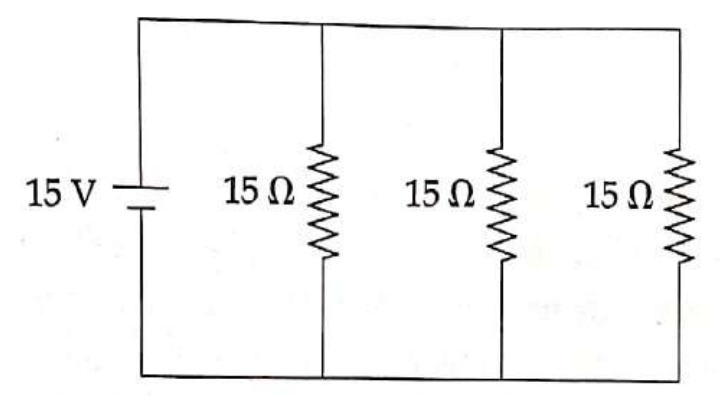
The current in the circuit is :
- A. 4 A
- B. 1 A
- C. 2 A
- D. 3 ACorrect
Explanation. Three 15 Ω resistors in parallel give \(R=\frac{15}{3}=5\) Ω. Current \(I=\frac{V}{R}=\frac{15}{5}=3\) A.