
Current Electricity: One Mark Questions, Book Back Answers and Notes
This unit is about charges in motion: electric current, drift velocity, resistance, and Ohm's and Kirchhoff's laws. You work with resistors and cells in series and parallel, the Wheatstone bridge, meter bridge and potentiometer. The unit closes with the heating effect of current and the thermoelectric effects of Seebeck, Peltier and Thomson.
Study this chapter
Asked in previous board exams
9 questions from this chapter came in 7 past public exams. Open any of them to see the answer and explanation.
-
March 2026
Two wires of A and B with circular cross section are made up of the same material with equal lengths. Suppose \(R_A = 3R_B\), then what is the ratio of radius of wire A to that of B ?See answer in the solved paper →
-
March 2025
In Joule’s heating law, when R and t are constant, if the H is taken along the y-axis and \(I^2\) along the x-axis, the graph is :See answer in the solved paper →
-
March 2024
A toaster operating at 240 V has resistance of 120 Ω. Its power is :See answer in the solved paper →
-
March 2023
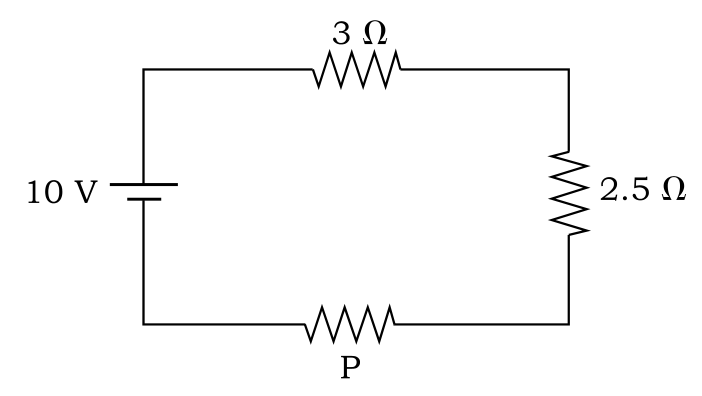
There is a current of 1.0 A in the circuit shown below. What is the resistance of P ?See answer in the solved paper →
-
March 2023
A carbon resistor of \((47\pm4.7)\ k\Omega\) is to be marked with rings of different colours for its identification. The colour code sequence will be :See answer in the solved paper →
-
May 2022
In India electricity is supplied for domestic use at 220 V. It is supplied at 110 V in USA. If the resistance of a 60 W bulb for use in India is R, the resistance of a 60 W bulb for use in USA will be :See answer in the solved paper →
-
May 2022
If a current of 7.5 A is maintained in a wire for 45 seconds then the charge flowing through the wire is :See answer in the solved paper →
-
Supplementary 2021
The internal resistance of a 2.1 V cell which gives a current of 0.2 A through a resistance of 10 Ω is:See answer in the solved paper →
-
March 2020
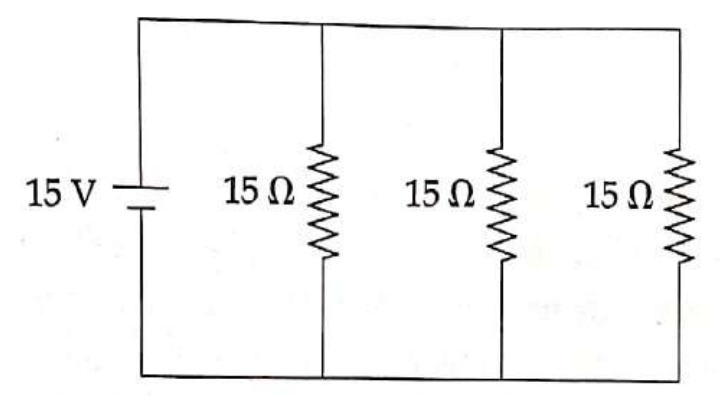
The current in the circuit is :See answer in the solved paper →
About Current Electricity
Medium ~150 min study
Unit 1 dealt with charges at rest. In this unit the charges move. A potential difference across a conductor sets up an electric field, and that field pushes free electrons along the wire to give a steady current. Every circuit you meet at home, from a tube light to a phone charger, works on these ideas.
The unit starts inside the wire. Free electrons move randomly, and an applied field gives them a small average drift velocity. From drift velocity and mobility you get current density, and from there the microscopic form of Ohm's law, \( \vec{J} = \sigma \vec{E} \). Once you have resistance, you can handle whole circuits. Kirchhoff's two rules, one based on conservation of charge and the other on conservation of energy, let you solve networks that cannot be reduced to simple series and parallel groups.
Book back questions often ask for equivalent resistance, the balance condition of a Wheatstone bridge, the effect of temperature on resistance, and potentiometer readings. Numerical answers depend heavily on sign conventions in Kirchhoff's loop rule, so practise a few two-loop circuits carefully.
What you'll learn
- Calculate drift velocity and mobility of electrons in a conductor.
- Use Ohm's law to find current, voltage or resistance in simple circuits.
- Find equivalent resistance and power dissipated in series and parallel networks.
- Apply Kirchhoff's rules to find unknown currents and voltages in multi-loop circuits.
- Explain how the meter bridge and potentiometer work and what they measure.
- Distinguish between the Seebeck, Peltier and Thomson effects.
Before you start
- Electric potential and potential difference from Unit 1.
- Structure of atoms and the idea of free electrons in metals.
- Solving two or three simultaneous linear equations.
Topics covered in this chapter
Current Electricity explained
What This Unit Covers
Current and Drift Velocity
Current is the rate of flow of charge, \( I = \frac{dq}{dt} \). Without a field, free electrons in a metal move randomly and there is no net flow. When a field is applied, they pick up a small average velocity opposite to the field, called drift velocity. Mobility is drift velocity per unit electric field. Current is linked to drift velocity by \( I = neAv_d \).
Ohm's Law and Resistivity
The microscopic form of Ohm's law relates current density to the electric field. For a wire of length \( l \) and area \( A \), this becomes the familiar \( V = IR \), with \( R = \rho \frac{l}{A} \). Resistance depends on the shape of the conductor, while resistivity depends only on the material and its temperature. The unit also covers the colour code used for carbon resistors.
Heating Effect and Power
As electrons drift, they collide with the vibrating ions of the lattice and give up energy as heat. Joule's law gives the heat produced as \( H = I^2Rt \), and electrical power is \( P = VI \). Electric heaters, irons and fuses are the textbook applications.
Resistors and Cells in Combination
Resistors in series carry the same current and their resistances add. Resistors in parallel have the same potential difference, and the reciprocals of their resistances add. Cells are combined in the same two ways: in series to get a larger emf, and in parallel to supply a larger current. Each cell has an internal resistance, so its terminal voltage is less than its emf when it supplies current.
Kirchhoff's Rules
The current rule (junction rule) says the algebraic sum of currents meeting at a junction is zero, which follows from conservation of charge. The voltage rule (loop rule) says the algebraic sum of potential differences around any closed loop is zero, which follows from conservation of energy. Together they can solve any network, including circuits with more than one cell.
Wheatstone Bridge, Meter Bridge and Potentiometer
A Wheatstone bridge is balanced when no current flows through the galvanometer, and then \( \frac{P}{Q} = \frac{R}{S} \). The meter bridge applies this idea with a one metre wire to find an unknown resistance. The potentiometer compares emfs of cells and measures internal resistance. At the balancing length it draws no current from the cell being tested, which is why it measures emf more accurately than a voltmeter.
Thermoelectric Effects
In the Seebeck effect, a thermocouple made of two different metals produces an emf when its two junctions are kept at different temperatures. The Peltier effect is the reverse: when current passes through a junction of two different metals, heat is absorbed or given out at that junction, depending on the direction of current. The Thomson effect is heat absorbed or given out when current flows along a single conductor whose ends are at different temperatures. Thermocouples, thermoelectric generators and thermoelectric coolers are based on these effects.
Common mistakes to avoid
- Treating resistance and resistivity as the same thing. Resistivity is a property of the material; resistance also depends on length and area.
- Mixing sign conventions in the loop rule. Fix a direction for each loop and each current before writing equations, and stick to it.
- Taking the terminal voltage of a cell as equal to its emf. When the cell supplies current, the drop across its internal resistance makes terminal voltage smaller.
- Reading the colour code in the wrong order. The first two bands are digits, the third is the multiplier and the fourth is tolerance.
- Assuming Ohm's law holds for every device. Non-ohmic devices such as diodes do not have a linear V-I graph.
Test yourself on these with the practice test, then check the worked reasoning in the solved MCQs.
Frequently asked questions
If drift velocity is so small, why does a bulb glow as soon as the switch is on?
Drift velocity is of the order of \( 10^{-4} \) m s-1, a fraction of a millimetre per second. But the electric field is set up along the whole wire almost instantly, at nearly the speed of light, so electrons all along the wire start drifting at once. The bulb does not wait for electrons to travel from the switch.
Why does the resistance of a metal increase with temperature?
At higher temperature the ions in the lattice vibrate with larger amplitude. Free electrons collide with them more often, so the average time between collisions falls. This raises the resistivity, which is why metals have a positive temperature coefficient of resistivity.
When should I use Kirchhoff's rules instead of series and parallel formulas?
If a circuit can be reduced to one equivalent resistance, series and parallel rules with Ohm's law are enough. If it has several loops, more than one cell, or branches that are neither in series nor in parallel, use Kirchhoff's rules to find each branch current.
How does a potentiometer measure emf without drawing current?
You slide the jockey until the potential difference across a length of the potentiometer wire equals the emf of the cell. At this balancing point the galvanometer shows no deflection, so no current flows through the cell. With no current, there is no drop across its internal resistance, and the reading gives the true emf.
What is internal resistance of a cell?
It is the resistance offered by the electrolyte and electrodes inside the cell. When the cell supplies a current I, a voltage Ir is lost inside it, so the terminal voltage is V = E - Ir.
Where is the Seebeck effect used?
It is the principle of the thermocouple, which measures temperature from the emf produced between two junctions. Thermocouples can measure high temperatures in furnaces where an ordinary mercury thermometer cannot be used. The same effect is used in thermoelectric generators.
Last updated 15 September 2026